More PhotosMonday, May 25, 2009
Mantanani Resort
More PhotosWednesday, April 1, 2009
Proboscis Monkey, Only In Borneo
Source: www.tustrucos.com/Monday, December 22, 2008
Nunuk Ragang Legendary
Nunuk Ragang is a legendary red banyan tree traditionally located at the intersection of the left (Liwagu Kegibangan) and right (Liwagu Kawananan) branches of the Liwagu River to the east of Ranau and Tambunan in Sabah. The word "Nunuk" is a Dusun word for the Banyan tree, and "Ragang" comes from "aragang", the Dusun word for red. It was under this giant banyan tree that the village of Nunuk Ragang was founded and flourished. Tradition places this village as the original settlement grounds of the Dusun people who inhabit most of central Borneo.
In 2004, the quasi-government group Kadazandusun Cultural Association (KDCA) set up a memorial near Tampias at the site of what they believe is the original village. The memorial, which was built in the form of a huge fig tree, contrasts with the surrounding modern palm oil plantations. The association conducts annual pilgrimages to the site, timed to coincide with the inauguration of its paramount chief, the Huguon Siou - From Wikipedia, the free encyclopedia
Tuesday, June 3, 2008
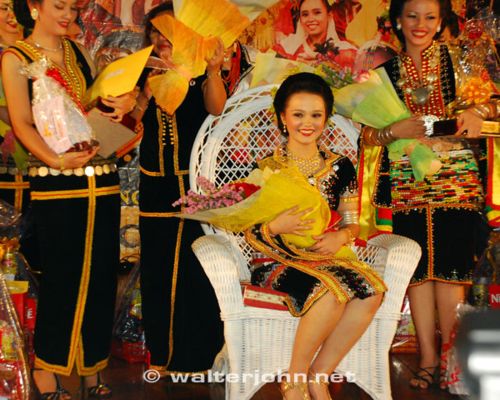
The Unduk Ngadau of Kaamatan Beauty Queen
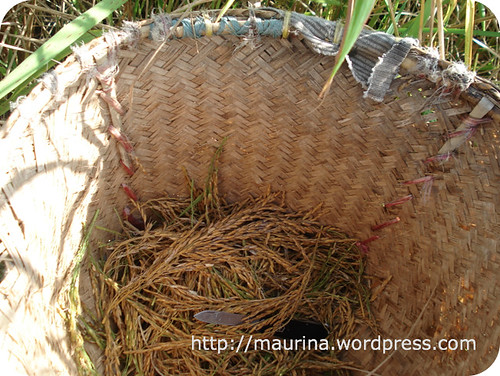
That year, the people had never seen such a harvest. It was plentiful. Kinoingan had done as Huminudun instructed He also kept away the first day’s harvest in the kakanan and harvested the first seven stalks of rice from the rice plot. The seven stalks of rice represented Bambaazon, the spirit of the padi or rice.
Saturday, April 19, 2008
Sabah Handicraft Exhibition
April is special month for all handicraft maker because April, 2008 is handicraft month. Sabah is known for its various ethnic handicraft, using skills that are passed down from one generation to the next. In this exhibition, get to know the various types of handicraft found in Sabah and the craftspeople behind it. This event is held every Saturday & Sunday for the month of April 2008 - SabahTourism.
Organiser : Monsopiad Cultural Village
Contact Person : Monsopiad Cultural Village
Telephone : +6088 774337, 774336
Fax : +6088 761680
Email Contact : info@monsopiad.com
Event Website : http://www.monsopiad.com/
Monday, April 7, 2008
Sabah Handicrafts: Tekiding, Sinonson (Tree Bark)
Tuesday, March 25, 2008
Kota Kinabalu City - Places of Interest
Inside are various Galleries housing Natural History, Ceramics, Ethnography and Archaeology exhibits, among others ...
Ceramics, traditional weapons and costumes reflect the diversity of the State's culture and traces Sabah's early trade links with the neighbouring countries of Southeast Asia and China. The museum also houses musical instruments, tools and ritual paraphernalia.
There is a Heritage Village on the Museum grounds where you can enter and experience different types of traditional houses of the various indigenous groups of Sabah. Cultural activities are held here from time to time.
The Sabah State Museum is located on Jalan Bukit Istana Lama, Kota Kinabalu, 4 km or about 15 minutes from the KK City Centre. For more information, visit http://www.sabahtourism.com/.
Enjoy a round of Water Basketball or have a go at the Water Cannons. Other facilities include a cafeteria, an air-conditioned lounge with equipped with Astro, lazy chairs and a souvenir shop. The Park can also help organize special events, such as children's birthday parties, making it a memorable event for your little one. Contact the Park for their Special Packages. Getting there, please visit http://www.sabahtourism.com/.
Inside are housed an auditorium, two mini-theatres, exhibition foyer, a gymnasium, kindergarten and Research library. On the 18th floor is the revolving restaurant Atmosphere where you can enjoy a different dining experience. How to getting there? Look at here http://www.sabahtourism.com/attraction.php?ID=3.
At the Village, visit the Tangkob or Grainery where the padi is housed.Kotos Di Monsopiad or Monsopiad's Main House is dedicated to the life and times of Monsopiad and his descendants. On display are ceramic jars, padi grinders, bamboo items as well as the costume of Bobohizan Inai Bianti, direct descendant of Monsopiad and very senior high priestess.
Other interesting exhibits include the massive monolith which invokes a dozen legends, the traditional restaurant and of course Siou Do Mohoing, or the House of Skulls, where all 42 ‘trophies' of Monsopiad hang from the rafters. Getting there from KK City centre? Visit at http://www.sabahtourism.com/attraction.php?ID=78.
Award of 'Airline Of The Year 2007' - AirAsia

The Airline of the Year 2007 award is the highest level of recognition and honoured to the airline for its notable achievements in the aviation industry and outstanding strategic contribution over the course of the past year. AirAsia has had the greatest impact on the development of the airline industry in the region, established itself as a leader, and the benchmark for others to follow.
Tony Fernandes, Group CEO of AirAsia received the award before 300 distinguished members of the aviation community. The Gala Awards Ceremony was held as part of this year’s fourth annual Aviation Outlook Summit, showcasing airline and airport CEOs from around the Asia Pacific and Middle East regions.
AirAsia has previously won several awards from CAPA – AirAsia was a joint winner of the Airline of the Year award in 2003, won the Asia Pacific Low Cost Airline of the Year 2004, followed by the Asia Pacific Aviation Executive of the Year 2005 which was awarded to Tony Fernandes, Group CEO and Founder of AirAsia.
Tony Fernandes, Group CEO of AirAsia, said, “This is our best year yet! Winning the award is a testament to our resilience, commitment and discipline to deliver what we know best which is for everyone to fly and this exemplifies our endeavor in rising up against the big incumbent players. We never underestimated the strength of our passion and spirit, and our 5,000 staff’s concerted and relentless efforts in delivering their best and will continue to do so.” “Who would have known such a small airline from Malaysia which started out with RM40 million in debt would have such impact on the aviation landscape today. But we are more sentient than ever that there’s much work to do from now onwards. We know we must not rest on our laurels. The best part is, we know where we’re heading and with AirAsia X, our enterprising venture ever, it is time for us to spread our wings further from Asia to beyond,” concluded Tony.
Peter Harbison, Executive Chairman of the Centre for Asia Pacific Aviation, “AirAsia is poised to become the biggest airline in the region next decade, commanding a highly influential position in regional aviation. In aviation history terms, AirAsia’s arrival on the international aviation scene is unprecedented. Perhaps only Ryanair and easyJet have made such meteoric rises. Barely in existence only five year ago, in another five years, it promises to be the largest airline in the region. In the course of this phenomenal advance, it has changed the shape of Asian aviation and strongly influenced government attitudes to regulatory reform.” Mr Harbison added, “AirAsia continues to provide the global benchmark low cost operation. Its new ventures this year include an extension of the cross-border joint venture model it pioneered in Asia, as well as the launch this week of its long-haul AirAsia X offshoot, confirming the airline's role as a true innovator and a catalyst for positive market change in this region and beyond”.
About AirAsiaAirAsia has carried over 40 million passengers to date, grown from a 2-aircraft fleet to 62 today and now, has the most extensive low cost route network in the region of over 80 routes – all within the grasp of six years in operation. The airline today is proud to be a truly ASEAN airline with its network stretches across 10 ASEAN countries. For more information, please log on to http://www.airasia.com/.
Monday, March 17, 2008
Simpang Mengayau or Tip of Borneo, Sabah
Monday, March 10, 2008
Tales of Kinabalu
When he made his return to China, he was given a grand welcome by his family. However, to his dismay, his parents disagreed with him about taking his Bornean wife back to China. Worse, they told him that he was already betrothed to a princess of a neighbouring kingdom. Having no choice (due to high respect towards his parents), he obeyed with a heavy heart.
Monday, February 25, 2008
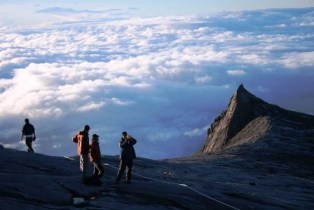
Mt. Kinabalu Climbing Package and Guide
Thursday, February 14, 2008
Sipadan - Diving Site Island

Sipadan is the only oceanic island in Malaysia, rising 2,000 feet or 600m from the seabed. It is located in the Celebes Sea east of the major town of Tawau and off the coast of East Malaysia on the Island of Borneo. It was formed by living corals growing on top of an extinct volcanic cone that took thousands of years to develop. Sipadan is located at the heart of the Indo-Pacific basin, the centre of one of the richest marine habitats in the world. More than 3,000 species of fish and hundreds of coral species have been classified in this ecosystem.
Normally rare diving scenes are frequently seen in the waters around Sipadan: schools of greenback turtles and hawksbill turtles nesting and mating, schools of barracuda & big-eye trevally in tornado-like formations, pelagic species such as manta rays, eagle rays, scalloped hammerhead sharks and whale sharks.
A mysterious turtle tomb lies underneath the column of the island, formed by an underwater limestone cave with a labyrinth of tunnels and chambers that contain many skeletal remains of turtles that have become lost and drown before finding the surface.
Diving at Sipadan Island - http://www.sipadan-resort.com/ , http://www.divetheworldmalaysia.com/ , http://www.sipadandivingvacation.com/
Saturday, January 26, 2008
Tuesday, December 18, 2007
The Lost World of Maliau Basin
The Maliau Basin is one of the most spectacular and pristine natural features in Malaysia, and indeed, Southeast Asia."The Maliau Basin is one of the most spectacular and pristine natural features in Malaysia, and indeed, Southeast Asia. The Maliau Basin is almost unvisited and completely uninhabited by man. It is located in south-central Sabah, about 40km north of the Indonesian border
at between 116° 40' - 117° 2' and 4° 40' 4° 50' N.
While all of this region is rugged, remote and forested, the Maliau Basin is distinguished by its steep slope up to 1,500m in height, making it insurmountable on foot from most directions. The size of the enclosed Basin is 390 sq. km with a maximum diameter of 25km. The highest point is Mt. Lotung, on the north rim which is about 1,900m elevation. It is drained by a set of radiating tributaries of the Maliau River, one of which descends a series of waterfalls, known as the Maliau Falls.
The river drains through a gorge into the Kuamut River which in turn feeds into the Kinabatangan River, the longest river in Sabah. The basin is a faunal haven for lowland animals such as wild pigs, barking deer, proboscis monkey, clouded leopard, pythons and many species of birds including the rare Bulwer's Pheasant, the Crimson headed Partridge and the Peregine Falcon have been sighted here.
Since 1970, the area has formed part of a large timber concession assigned to Yayasan Sabah. Since 1981, however, the Maliau Basin and another large area, the Danum Valley, have been designated Conservation Areas within the Foundation's long-term Forest Management Plan, to remain unlogged for purposes of wildlife conservation, education and research.
From - Virtual Malaysia
Sunday, December 2, 2007
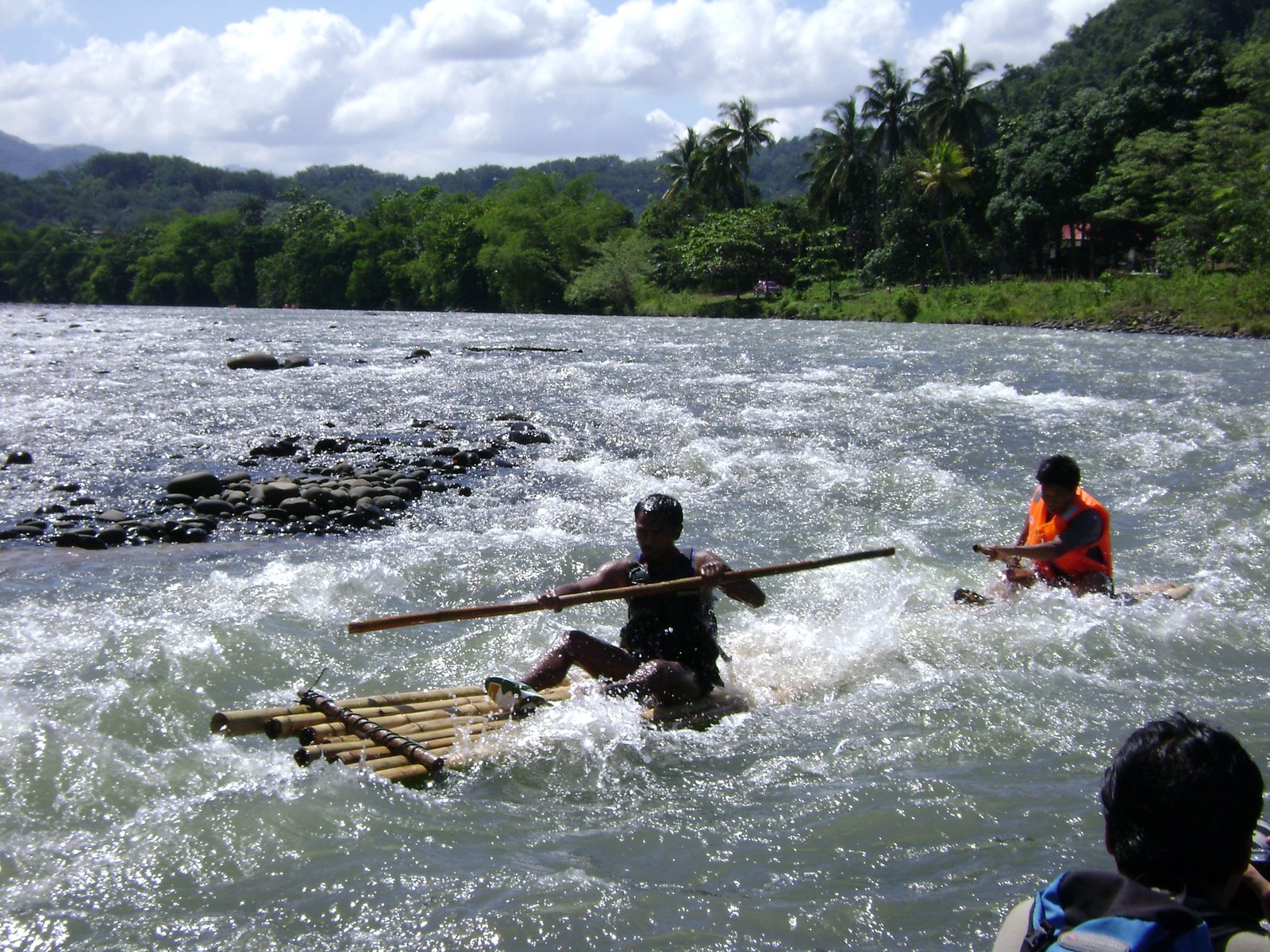
Kiulu 4M Bamboo Rafting Challenge 2007
Introduction - Kiulu 4M Challenge (1998-2006)
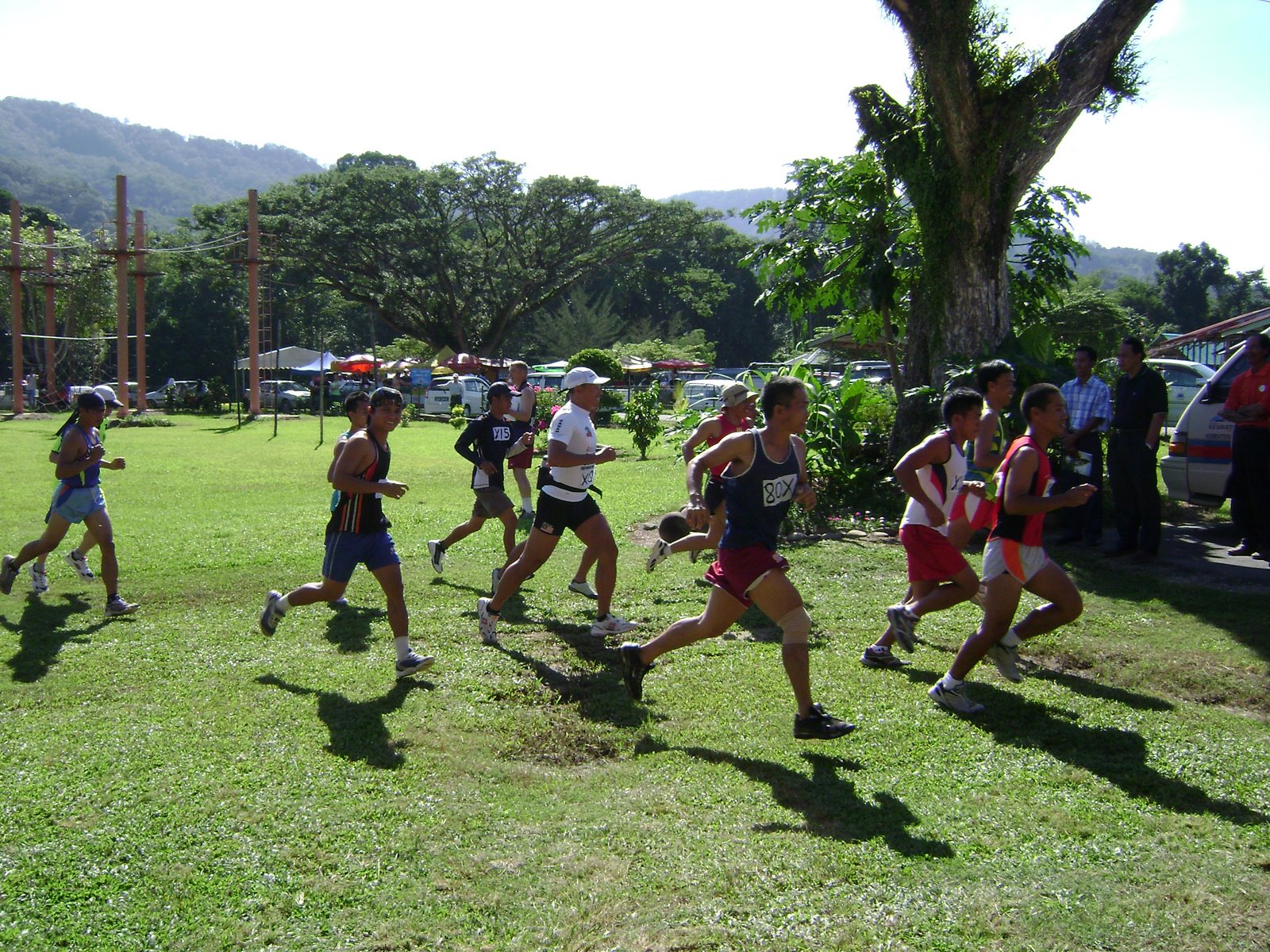
Besides being a sport event, the K4MC is also a noble endeavor to protect and preserve nature, in particular the Kiulu River. Among the objectives of the challenge are to promote traditional sports as an eco-tourism product of Kiulu to create opportunities for active local participation in the tourism industry and instill environmental awareness among the community.
Organizer of the one-day event have also introduced a new category called X-treme 4KMC for men above 21 years old only which involves running and bamboo rafting over a distance of 13 km.
This information is available at http://www.sabahtourism.com/culture.php?ID=21